As I've shown in the past, the run value of an ABS Challenge is impacted greatly by the ball-strike count (especially the 3-2 count which will flip the plate appearance walk <==> strikeout, while a 1-0 v 0-1 count is hardly eventful), as well as the runners on base (especially bases loaded in which case an entire run is on the table).
Looking at calls where the run value has very low impact (under 0.1 runs), low impact (0.1 to under 0.2 runs), medium impact (0.2 to under 0.3 runs) and high impact (at least 0.3 runs), we can see how our players perform. When it's a very-low-impact challenge, the breakeven point is much higher, and so we expect a much higher success rate. You can't risk a challenge to gain 0.05 runs, but you can risk a challenge if you can gain 1.8 runs.
Let's start with pitchers, where they challenged 28, 26, 22, 20 times respectively for the very-low thru to the high-impact groups noted above. Pitchers are smart! At least directionally. They succeed 54%, 31%, 32%, and 15% respectively. So, 54% success rate when it's very-low-impact and 15% when it's high impact. Like I said: directionally-sound. But magnitude-wise? Ouch. A very very big ouch.
How about their battery mates? 62%, 62%, 61%, 48%. So, catchers are very smart, both with a big success rate of 48% with the high-impact challenge, and an even higher success rate at lower impact. What is interesting is that catchers basically have only TWO mindsets: high-impact and other. Which is somewhat fine. In that regard, they should just stop challenging the very low-impact pitches: 62% to only gain ~0.06 runs is just not worth it.
How about batters? Success rates of: 50%, 53%, 41%, 40%. So, the same directional/binary mindset as catchers, except different thresholds. Batters are looking to be riskier when run value is .20+ runs (while catchers are looking for .30+ runs). And really, getting 50% overturns while gaining ~0.06 runs is really not worth it.
So, since all three groups are able to isolate the high-impact situations, they should be challenging those alot more while challenging the low-impact pitches alot less.
What's new: The Slate Truck has an official price: $24,950. We also know the final specs for its estimated range, charging capabilities and more.
Why it matters: The Slate will be one of the cheapest cars — EV or otherwise — when it goes on sale later this year.
Edmunds says: While a bare-bones truck like this won't be for everyone, it no longer feels like a pie-in-the-sky dream. Slate comes across like it's the real deal.
When Slate dropped its bare-bones Truck last year, there were plenty of unanswered questions. The biggest one was the price — something we worried would be affected by the federal EV tax incentive ending last September. But alas, we now know the big specs about Slate's little truck: 205 miles of range and a $24,950 price tag (excluding an unknown destination charge).
The Slate's finer details come into focus
In addition to the price, Slate announced that there will be just one battery pack — there used to be two, but in the name of simplification and keeping costs down, that's no longer the case. The 64-kWh pack sends power to a single 181-horsepower electric motor at the rear axle. Slate estimates that its little pickup will get 205 miles of range, but an official EPA rating is still a few months away.
With the Telsa-style NACS charging port out back, buyers will get access to the Supercharger network, and the Slate's peak charge rate is 120 kW. At a Level 3 DC fast charger, the Slate will be able to juice up its battery from 20% to 80% in 30 minutes. On a Level 2 charger — like the one you can install at home — Slate says you can get a full charge in just 4 hours.
The last key piece of info — at least for truck users who plan on using this as, well, a truck — are payload and towing numbers. Payload (how much you can haul in the bed) is rated at 1,550 pounds, which actually bests the subcompact Ford Maverick (1,500 pounds). Max towing is 2,000 pounds for the Slate. For comparison, the Maverick is rated to tow 2,000 pounds out of the box, but you can option a tow package that ups that number to 4,000 pounds.
Here's what the Slate is like on the road
I was at Slate's design studio in Los Angeles to take a look at the bare-bones Truck and some other, more customized variants. I was reminded that it's about 1 foot shorter than the Ford Maverick, a truck I've become pretty familiar with ever since we added one to our One-Year Test Fleet.
The Slate Truck is cute and has real charm in person. The panels are made of a glass-injected polypropylene composite (try saying that five times fast) and are super dent-resistant. But if you do find yourself in a fender bender, you can just buy a new panel, pop off a few screws and put a new one on. There's no paint matching to do and no body shop to fuss with. Most of the panels (except the doors) can be swapped out this way. I like that.
The Slate Truck looks and feels a lot more finished than the last time I saw one. The panel gaps outside are much tighter, the build quality is generally more solid, and it looks ready to hit the road. So that's what I did — from the passenger seat, anyway.
Would you be surprised to hear the Slate feels like a small truck on the road? It doesn't ride as firmly as a body-on-frame vehicle like a Ford Ranger or Toyota Tacoma because it isn't. Slate's engineers initially considered that body style before quickly realizing it made more sense to integrate the battery pack into the body itself, ditching a traditional frame. The Slate isn't exactly plush, but it's compliant over bumps and stays relatively settled on LA's terribly maintained roads.
Even though 181 hp doesn't read like all that much on paper, Slate's engineers tell me the electric motor is tuned for low-end torque. That comes through pretty much immediately; you'll feel a deep shove into the seat when you mash the throttle. The Slate might have less power than a Volkswagen Golf GTI, but there is zero doubt in my mind that this electric truck is a heck of a lot quicker from 0 to 30 mph, and perhaps beyond. I can't wait to find out for sure at our test track.
The biggest takeaway is how airy the cabin feels when you're riding along. Even though it looks super small from the outside, the Slate's cabin has more than enough room for two large adults to sprawl out. The seating position is just right for both the driver and passenger, and there's plenty of head- and legroom for my 6-foot frame.
If there's one knock, it's the noise. Even at relatively low speed (around 45 mph), wind noise is obvious if not deafening — highway speeds will likely be worse. This could come down to the fact that I'm riding in what is still technically a prototype. Maybe Slate will tighten up those panel gaps and better insulate the cabin before it starts delivering trucks to customers.
Customization galore
Slate will offer tons of optional goodies that you may or may not want. Vinyl seat covers come in at $250 and zip on or off for easy cleaning. There are dozens of color options for interior trims. Slate will even let you spin the color wheel when it comes to a wrap (which has been specially designed to better bond with the car's plastic body). That means your Slate can be any color you want. The possibilities are limitless. It's like a Rolls-Royce.
Deliveries are slated (sorry) to begin at the end of this year. So if the Slate still catches your fancy, you might want to turn your reservation into an actual deposit. We'll have more on this super basic pickup once we get our hands on one for an extended period later this year. Stay tuned for when we put the Slate through the Edmunds EV Range Test, tell you what it's like to drive and much, much more.
What's new: The Slate Truck is one of the cheapest cars on sale right now, starting at just $24,950 (not including an unknown destination charge).
Why it matters: The Slate brings a ton of customization and flexibility to a truly bare-bones vehicle canvas.
Edmunds says: We spoke to Slate's head of engineering to find out what it took to keep costs low.
The Slate Truck is going to start at $24,950 (before an unknown destination charge is applied), and that makes it one of the cheapest cars in the country, EV or otherwise. But EVs are generally quite expensive, almost always more than their gas-powered counterparts. So how did Slate do it? After taking our first ride in the truck, we spoke to some of the company's key players to find out.
When Slate first introduced its truck, we were told there would be two battery packs. But now, there's just one lithium-iron-phosphate (LFP) pack that powers the truck's single 181-horsepower electric motor.
"We just recognized we had an opportunity to move to an LFP with a little bit more energy, and were able to get that 205 miles of range that all we all honestly wanted," said Eric Keipper, Slate's head of engineering. A single battery pack makes sourcing parts and assembling the car a simpler job, which reduces complexity — and costs.
Slate's engineers also reduced the total number of parts in the truck. Slate says a typical truck has around 1,840 "major components," but this small electric truck has approximately 800. Think body panels, energy control modules, doors, suspension components — big-ticket items like that. Plus, the body panels themselves aren't made from metal, but a much cheaper plastic polymer that's both dent-resistant and easy to swap out should you find yourself in a minor crash.
Keipper also mentioned the team made specific content choices very early on in development to keep that "bill of material" cost as low as possible. The truck's limited driver assistance systems (it only comes with regular ol' cruise control) meant no costs for complicated sensors, and the lack of an infotainment interface reduced the need for wiring and control modules. The Slate doesn't even have a heat pump like so many other EVs. That might make living with one in colder climates more difficult, but just using a standard heater keeps things simpler and cheaper.
A large chunk of what makes up the Slate is off-the-shelf bits, meaning the company didn't have to develop key components in house. The electric motor, some vehicle control electronics, the steering column and more were all sourced from other companies and suppliers, and then Slate tuned those parts to best fit its truck's needs.
The suspension is a good example of how Slate cut costs. "[The truck] has a simple MacPherson strut suspension in the front and we've got a De Dion [non-independent] axle in the rear," Keipper told us. De Dion axles aren't very common in passenger cars anymore because, frankly, they're a little archaic. But they are also much cheaper than a more sophisticated independent rear suspension would be.
Servicing is also part of the deal. When a brand launches a car, it has to support what its customers buy — this is something Rivian found out the hard way when it launched the R1T and R1S. Slate is also taking an off-the-shelf approach here, though less literally. The company is partnering with RepairPal, which will offer 3,000 locations across the U.S. that will be able to service Slate's trucks. Launching your own service network is a hugely costly endeavor, and this is yet another way the company is pairing things back to minimize overhead.
The Slate is an interesting exercise in how small, very deliberate decision-making can lead to huge savings, and not all of them will be obvious. No, you aren't getting the creature comforts that so many modern buyers have become accustomed to, but that's also part of this truck's appeal. If you've been craving something simple that you can customize to your heart's content, then this cheap little trucklet might be the one for you.
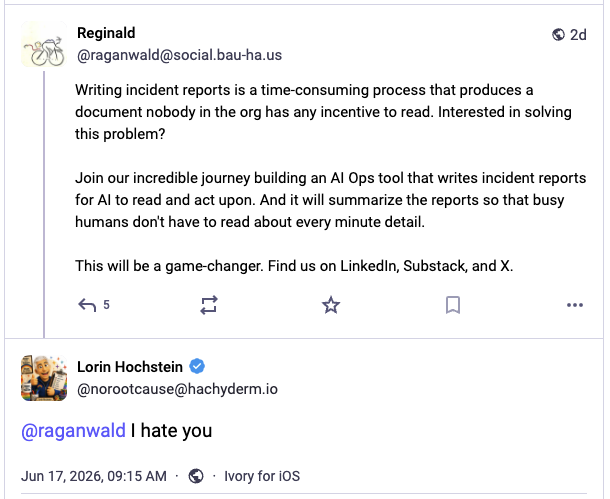
Braithwaite’s post is dripping with sarcasm, but make no mistake, incident reports written entirely by LLMs is coming. And I am not looking forward to this future.
Before I dive in here, I want to note that there is a lot of toil you need to do in order to gather the data you need to write a good incident report, and LLMs can help significantly reduce that toil. I’ve got no issues there. But there’s a world of difference between using LLMs to help you assemble the ingredients involved in writing an incident report, and using an LLM to actually write the report itself.
Braithwaite’s post is horrifying to me precisely because of the seduction of the LLM as a tool for generating an incident report. After all, you can just ask it to write the report, and it’ll do it. And that’s exactly what scares me.
There’s a famous quote by the cartoonist Dick Guindon: “Writing is Nature’s way of showing you how sloppy your thinking is“. You might think you understand a concept, but it’s only when you put metaphorical pen to paper, when you actually try to explain the concept in written words to a potential reader, that you realize how fuzzy your understanding actually is. Writing in your own words forces you to confront how much you actually understand what it is that you’re writing about. Or, as Leslie Lamport put it, “If you’re thinking without writing, you only think you’re thinking.”
Having an LLM generate the text of an incident write-up bypasses this thinking step. Now there’s no human in the loop of the writing process that has to confront whether the explanation is actually consistent with the evidence that they’ve gathered. Instead, what you get is a plausible explanation of what happened to someone who is not intimately familiar with the details. They might read, nod along, and think, “yes, that makes sense.” But the LLM may have invented couplings between systems that aren’t there, and may miss critical interactions that were actually part of the incident, and because nobody did the hard work of actually synthesizing the data to do the write-up, nobody will notice. Because if you’re trying to reduce the writing effort, how much effort are you really going to put into checking the LLMs work.
In my view, LLM-generated incident write-ups are more dangerous than using LLM for coding or for AI SRE style tasks. For coding tasks, there’s always a testing step to check that the code exhibits the desired behavior, even if nobody looks at the code itself for meaningful details. For AI SRE tasks, either the LLM output helps you resolve the incident, or it doesn’t. In both cases, Nature is the ultimate arbiter of the LLM output.
But incident write-ups aren’t like that. The consequences of a poor report aren’t immediately apparent the way incorrect code or an incorrect operational diagnosis are in the moment. Instead, we get incident reports that have the superficially correct form, but are actually incorrect, with no obvious test for correctness.
And, because incident reports are time-consuming to write, the temptation to use AI tools to generate them will be overwhelming. But these LLMs will not go around talking to people that were involved in the incident. These reports will be simulacra; they will have the right form, but they will not provide readers with genuine insights into the nature of the system. The amount of learning will be significantly curtailed.
And, yes, people will probably use AI to summarize them as well.
(CAUTION AHEAD: This post is rated “M” for… “Math”.Yes, this forecast uses obscure math vocabulary. If you were thinking you were coming to Facebook explicitly to avoid having to think about — or learn about — math, here is the TL;DWM(“Too Long; Don’t Wanna Math”) version: It’s going to get hot on Sunday and Monday, then it’s not. Thanks for stopping by!)
As you’ve probably heard, it’s going to get hot around Seattle. Yes, avoiding record heat is likely the preferable choice for a vast majority of people, especially in a region where air conditioning is about in similar abundance to Capitol Hill street parking.
BUT! If you were going to have to endure a heat wave, this is about the best version you can hope for, as there are a number of ways it could have been worse.
AND SOMEHOW YOU’RE GOING TO TELL ME USING ALGEBRA OR SOMETHING?
Maybe more like geometry.
First, the forecast: We’re already into the sunny phase, now it’s just the temperature climb. Highs on Friday will reach the low-mid 70s around Seattle, then reach close to 80 on Saturday.
As a ridge of high pressure intensifies in the region over the weekend, we’ll start to bring in some warm, easterly winds that are the key to our local heat waves. The air undergoes a dual process of heating and drying as it blows over and then sinks down the western slopes of the Cascades, bringing a California/desert-like heat.
That heating engine starts to rev up on Sunday, with highs reaching the mid-upper 80s, and peaks on Monday with highs now pegged to reach the low 90s around Seattle; hotter toward the foothills and a little cooler along the coast.
91 DEGREES IN SEATTLE SEEMS PRETTY YUCK. HOW WAS THIS BETTER?
There’s what I count as at least five items in our favor with this heat wave that will help ease the impacts.
1- It’s a dry heat. With the easterly wind component, it won’t be humid at all, so your sweat will be more effective at keeping you cool (especially if, say, you’re playing soccer in front of billions of fans…)
2- While there will still be some fire danger with the hot and dry winds, it certainly helps that we had all that rain just a few days ago and have had occasional rain the past 6 weeks as opposed to a weeks-long bone dry streak leading into this heat.
3- It could have been hotter. The initial long range models were suggesting perhaps mid to even upper 90s were in the realm for the peak of the heat (some Euro ensemble models had 101-103!). We’ve already seen other heat waves around the planet in the first few months go well beyond the norm with the record-obliterating heat in the Desert Southwest at the end of March and the intense heat wave in Northern Europe a few weeks ago.We still have scars from June 2021 around here. But this will NOT be that kind of heat. (Though I do give kudos to the models for correctly sleuthing out a heat wave pattern for us 11-12 days in advance!)
4- There are places to escape the heat that aren’t far. It’ll still be warm on the coast on Sunday and near the shorelines, but more like upper 70s to low 80s.
And 5: It’s not going to last very long. Really, it’s just one day of the hottest heat. And then unlike stubborn Heat Domes that last for days, this ridge breaks down pretty quick and marine breezes start to cool us off as soon as Tuesday, increasing their cooling power through the week.
In fact, if you were to chart the high temperature forecast this week on a graph, it would look much like a parabolic curve (aaah! Math!)
What’s a parabolic curve? Essentially in this case, it’s an upside-down “U”.
The high temperatures gradually ramp up, peak, and then ramp down almost equally as fast.
The true math majors would look at the forecast and say it’s not *truly* parabolic — for that to happen the highs before the heat wave would have to equal the highs behind it. Right now we’re at 72-80-86-91-83-76-73. But since when do we have to be exact with math?
But more importantly, the forecast is mimicking a parabola, and not a flat ridge of days-long heat. The Monday Belgium-Egypt World Cup match will indeed be broiling. But by the time the USA match against Australia arrives next Friday, we should be back down in the 70s — perfect weather to turn that parabolic “frown” upside down 🙂
This is not a situation where one side is right and the other is huffing paint. (O, that it were!) Each side is grappling with a real, alarming, escalating threat to the company’s existence, and the closer they look the more (again: real, alarming) evidence they find.
The enthusiasts are not wrong. We are starting to see real, non-imaginary, discontinuous leaps in capabilities from teams that lean in hard to working with AI. And this does not feel like a normal technology cycle where you can wait for the dust to settle; teams that sit this out while competitors are hustling could be out of business before the dust settles. That’s a real, existential threat.
The skeptics are also not wrong. When you ship code faster than engineers can read it, in domains where nobody has full context, you are making withdrawals from a trust account that took years to build. Reliability degrades, institutional knowledge evaporates. You end up with systems nobody understands, products burbling into incoherence, and on-call rotations that grind people up and spit them out. That is ALSO a real existential threat.
She goes on to say that “the wins and costs are happening to two different groups of people. There is no natural feedback loop.” Interesting read.
 Log in

 reply
reply