2838 stories
·
0 followers

The demon of the gaps

1 Share
Mephistopheles (a medieval demon from German folklore) flying over Wittenberg, in a lithograph by Eugène Delacroix.

Modern software systems contain within them a mind-boggling level of complexity. As software engineers, we make this complexity manageable through techniques like decomposition, information hiding, and abstraction. We endeavor to break our systems up into components that interact over well-defined interfaces. By doing this, the surface exposed to individual software engineers is dramatically reduced: no individual has to understand how the entire complex system works in order to contribute to their system. Instead, each software engineer needs to understand only the individual component that they work on, along with the interfaces of the other components that they interact with. Decomposition is synonymous with analysis, where you study a larger thing by breaking it up into smaller pieces that are more amenable to understanding.

You can see this strategy of complexity management in action in microservice architectures. An engineer needs to understand the service that their team owns, and the interfaces of the services that their team calls out to. This architecture effectively bounds the information that an engineer needs in order to work effectively. Microservice architectures aren’t there for scaling the software itself, they’re there for scaling the software organization.

Unfortunately, when the system breaks down, this complexity management strategy breaks down itself. Just as hurricanes don’t respect political boundaries, system failures don’t respect component boundaries. Yes, sometimes the problem in a software system is limited to the failure of a single component. Those are the easiest cases to diagnose and mitigate. However, the hairy incidents are the ones that arise due to unexpected interactions across components. Maybe you have several services that are throwing errors, or maybe none of the services are throwing errors but customers are still seeing incorrect behavior. There’s no obvious change that correlates with the start of impact, or maybe you don’t even know when the impact started because the customer impact isn’t reflected in your existing metrics.

When you’re in the throes of an incident that involves an unexpected interaction, this architecture that was built for managing complexity now works against you. Because you’ve built an analysis solution but you’re now faced with a synthesis problem. You need to understand how the pieces all normally fit together to function in order to determine what is going wrong with the system right now. You’ve optimized to avoid requiring anybody to understand how the whole thing works, but now the whole thing isn’t working, and no one person knows how the whole thing works.

The job of the incident responders is to collectively figure out how to do that synthesis. You’ve brought together a group of people who each understand the functions of different components of the system, and you need to work together to build enough of an understanding of how the system functions to debug what’s going wrong. As an ad hoc team, the incident responders have to move up and down the abstraction hierarchy to figure this out.

This sort of in-the-moment reconstruction of system function from component parts is an essential part of incident response for the most complex incidents, but it’s rarely treated as first-class work that’s worthy of study and support. The recent book Crisis Engineering by Marina Nitze, Matthew Weaver, and Mikey Dickerson is the exception that proves the rule: they do discuss the work of building a model of the system during a crisis to help figure out what’s gone wrong. But I struggle to recall any other guidance I’ve read about incident response that talks about how to prepare for doing this sort of work. It’s important work, and it’s difficult, and the ability to do it well can have a huge impact on the time it takes to mitigate the hardest incidents. This is stuff that even the best individual humans struggle with, because it involves a group of humans working together effectively, with each person having a partial model of the system. And if the best humans struggle with it, I don’t think AI SRE tools are going to save us here: if the best humans struggle, the AIs will too. We need to figure out how to get better at this collectively. Like so many things, it’s a coordination problem.


Read the whole story
huskerboy
1 day ago
reply
Seattle
Share this story
Delete

Cloudflare CEO says AI bots now exceed human traffic on the web

1 Share
over a year earlier than anticipated, currently 57% to 43% by their metrics #
Read the whole story
huskerboy
3 days ago
reply
Seattle
Share this story
Delete

Where to Go if You’re a Cheese Lover

1 Share

Will travel for cheese! Like wine and chocolate, I’m always amazed at how much goes into creating all the varieties of cheese we come across in our day to day lives. There’s so much history and tradition behind each variety, it makes planning a cheese-themed trip all the more fun! Below is a list of places any cheese aficionado would love to experience.  

A Cheese Lover Bucket List

Québec Province, Canada

Considering its French origins, I’m not surprised Québec is home to over 500 varieties of cheese! The practice goes back to 1608 when Samuel de Champlain brought cows over from Normandy. You can create a whole itinerary around visiting all the different Québécois formageries! I’d start off in Québec City with a visit to Les Fromages de l’isle d’Orléans. There you can see where the very first cheese was made in both North and South America. Then check out the Eastern Townships’ Cheesemakers Circuit. Wherever you go, don’t forget to try cheese out in the most Canadian way possible – as curds on poutine!

Wisconsin

Any football fan immediately associates the Packers with the famous cheeseheads and for good reason – cheese is a serious business in Wisconsin! It’s the largest cheese-producing state in the country, accounting for over a quarter of all of our cheese production!! The history goes back to the 1800s when European immigrants settled in the territory and began building up dairy farms. It was Anne Pickett who officially established the first commercial cheese factory in 1841. For reference, today there’s around 1,500 factories producing 600 different kinds of cheese.

As a result, there are so many cheese-themed ways you can explore. If you’re in Madison, check out Fromagination for their artisan cheese. You can even take a class like how to put together the perfect cheeseboard. Outside of the city, look into doing a wine and cheese trail in Green Country or, if you visit in August, join the Tour de Cheese Bike Ride! You can also check out the Cheese Curd Festival in Ellsworth, and in Reeseville, Specialty Cheese Company is made of five old cheese factories that date back to the 1860s. Meanwhile, in Weyauwega, you can learn how Weyauwega Star Dairy made it into the Guinness Book of World Records for the longest ever string cheese! Check here for two different itineraries depending on which part of the state you’re in.

Emilia-Romagna, Italy

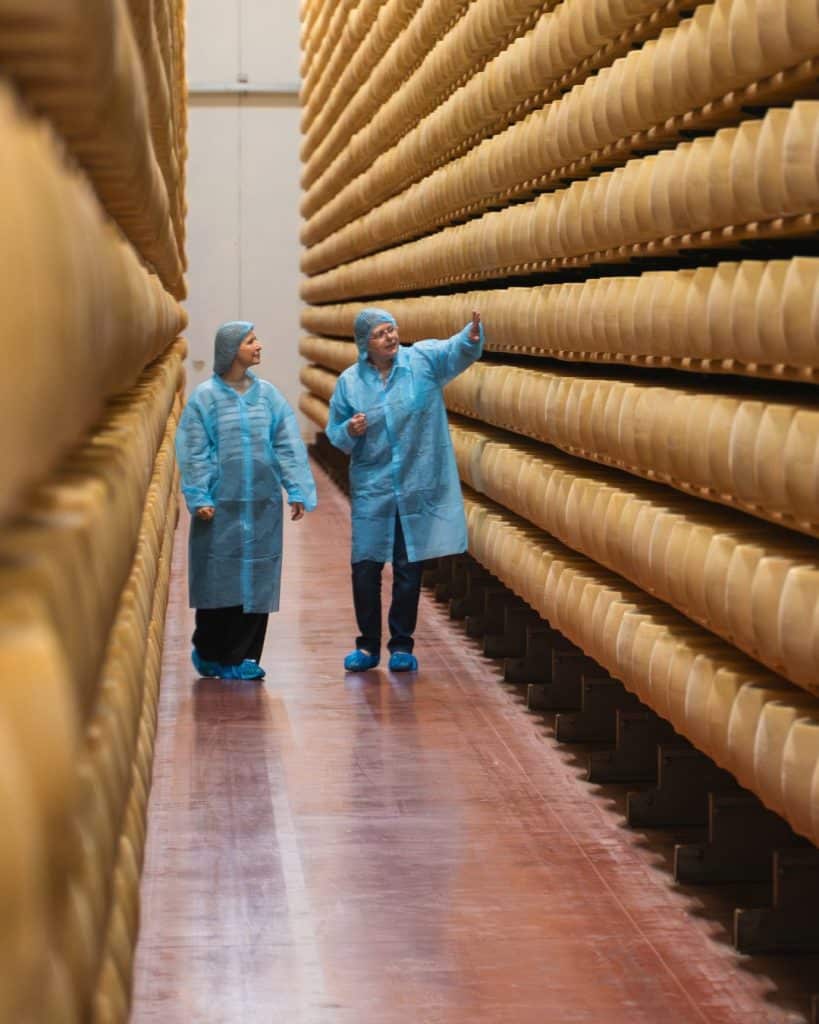
No cheese lover can miss out on the Italian region Emilia-Romagna! As a whole, cheese in Italy has a very long history going back to the Middle Ages and many cheeses can only be made in specific destinations. Italy calls it DOP or PDO (destination of origin), and Emilia-Romagna has six of them: parmigiano-reggiano, provolone valpadana, grana padano, squacquerone di romagna, formaggio di fossa di sogliano, and casciotta d’urbino. The key when planning your trip is to look for caseificios, or dairies and cheese factories. If you’re in Modena, take a tour of Caseificio Castelnovese to see their cathedral, aka the room where they store 77,000 wheels of parmigiano reggiano!!

Normandy, France

France is another country where cheese reigns supreme. Records show cheesemaking goes back to the Roman Empire (when France was part of what was known as Roman Gaul), and today there are over a thousand varieties of cheese. Like Italy with its DOP, they have appellation d’origine contrôlée (AOC/AOP), and currently 363 types of cheese have that designation. As a fan of camembert, I’d recommend centering your trip around Normandy, France. The region is also known for livarot, pont-l’evêque and neufchâte cheeses. All four come from the villages they originated from, making the perfect cheese route. Start off at Maison du Camembert, a museum dedicated to the cheese and then map out your trip from there.

Sonoma County, California

According to legend, cheese in California can be traced to pioneer Clara Steele in the 1800s when she began making cheese using wild cattle milk and her English grandmother’s recipe. And, of course, we have David Jacks in Central California to thank for Monterey Jack!

If I were to narrow your cheese-themed trip down to one area, though, I’d recommend going to beautiful Sonoma County. Most people think of it as wine country, but it also has a healthy artisan cheese industry and even hosts the California Artisan Cheese Festival every year. Follow their cheese trail for places like Achadinha Cheese Company, which specializes in farmstead cheese. This means they make the cheese (by hand!) on the same property where they raise their cows. The beauty is that they work with their cows’ natural cycles so their cheese differs every season based on the weather and what the cows are eating.

Vermont

Vermont may be one of the smallest states in the US, but it packs a punch when it comes to cheese production. Cheesemaking here goes back to the early 1800s, and in the mid-1800s, you could find cheese co-ops. Today it’s home to around 600 dairy farms and produces 150 types of cheese. Follow their cheese trail and plan your visit in September during the Vermont Cheese Week. If you’re not sure where to start, Crowley Cheese is one of the oldest farms in Vermont.

The Swiss Alps

As if anyone needs much of a reason to visit the Swiss Alps! Alpine cheese as a whole goes back to Roman times, and “Swiss cheese” was first mentioned by Pliny The Elder in the 1st Century. These days, cheese is part of Switzerland’s national identity and nearly all cow’s milk here goes towards cheesemaking. Because you’re in the Alps, one of the best ways to plan your trip is to hike or bike between cheese stops. There are different trails depending on which region you’re in. For example, in the canton of Bern, you can follow the Emmental Cheese Route via e-bike. And while in Bern, you can also stop by Gstaad for Molkerei Gstaad’s cheese grotto!

P.S. If a trip to Switzerland sounds like a lot, check out Traverse City, Michigan. Leelanau Cheese specializes in raclette cheese.

Cheese Valley, Netherlands

What a gouda way to end this list with none other than Gouda, Netherlands! Fun fact: this popular yellow cheese isn’t actually made in Gouda. It was only named after the city because Gouda had the sole feudal rights in Holland to trade cheese. Instead you’ll want to also plan a visit to what’s known as Cheese Valley. Start in Gouda with the Cheese Experience and if you’re in town on a Thursday, check out the Cheese Market at, well, the Markt square. Then plan to get out to Cheese Valley and follow one of these fun routes!

And there you have it! Some brie-lliant destinations any cheese lover would enjoy. Any I’m missing? Let me know below!

The post Where to Go if You’re a Cheese Lover appeared first on Samantha Brown's Places to Love.

Read the whole story
huskerboy
6 days ago
reply
Seattle
Share this story
Delete

Why Wildfire Experts Are So Worried About This Year’s...

1 Share

Why Wildfire Experts Are So Worried About This Year’s Fire Season. “Key environmental indicators show that the nation is a tinderbox, gripped by widespread drought and with a light snowpack in the mountains.”

Read the whole story
huskerboy
7 days ago
reply
Seattle
Share this story
Delete

Who Is Nick Bilton?

1 Share

Yesterday CBS’s Temu Leni Riefenstahl Bari Weiss fired everyone at 60 Minutes who had demonstrated they were willing to stand up to her and her paymasters David Ellison, his daddy Larry Ellison, and the Ellisons’ daddy Donald Trump. Then Weiss announced her new pick to lead the show: Nick Bilton.

The two reactions to this news were either “who?” or “him?” depending on how closely you followed tech journalism in the twenty-teens. If you weren’t following it, good call! Luckily you know a guy who was following it and regrettably that is me. Let’s visit the archives.

Who is Nick Bilton?

Bilton was born at the New York Times and grew up as “a design editor in the newsroom and a researcher in the research and development labs,” which are real jobs according to Wikipedia, before he became a Times technology columnist writing asinine takes like “what if Trayvon Martin had been wearing Google glasses when he was murdered” and “is your smartwatch giving you CANCER?” The latter was roasted so hard by The Verge’s Russell Brandom that it accreted a full page of editorial notes and corrections walking back the entire premise of the piece.

In 2013 Bilton published a book about the founding of Twitter and an anonymous hater collected some of the clunkiest sentences in a Tumblr titled “Nick Can’t Write.” Bilton was a pioneer of the kind of baffling metaphor that now plagues so much A.I. writing, such as:

In “Nick Bilton’s series of technology columns for idiots” he was also ahead of his time in producing the kind of aggressively vapid A.I. doom-marketing that has since become omnipresent. In a 2014 piece about the risks of out of control machine super-intelligence, he wrote:

Ok! You might expect him nail down a little more specifically what he means by “A.I.” but that’s not Bilton’s vibe. Instead he barrels ahead with speculation about a hypothetical cancer-curing medical robot, “self-replicating nanobots,” and autonomous weapons, apparently unaware that the first real victims of A.I. would turn out to be writers of baffling metaphor.

In 2016 Bilton left his childhood home, The New York Times, and went off to Vanity Fair where they let him pretend he discovered the Theranos fraud that John Carreyrou actually discovered, and ask “Will Mark Zuckerberg Be Our Next President?” You can tell that’s a serious question because the first sentence of the subhed is: “It’s a serious question.” He returned to A.I. again in 2023 seemingly for the first time, asking the same questions he had asked in 2014 but this time about technologies “most of which have been realized in just under six months.” Which six months did he mean, of the intervening decade? Who knows. Bilton’s post-Times style got so florid and overwrought that while I was writing about it in Tabs:

There may only be a single person about whom me, hyperglocal thinkfluencer Professor Jeff Jarvis, and circa 2014 Leah Finnegan would all say “wow, that guy sucks” and it’s Nick Bilton. He was the kind of tech commentator anti-talent who makes a smooth and remunerative career for himself by being enthusiastic about gadgets while seeming think-y and writing at a low fourth grade level. Sometimes these guys ascend to their proper heaven and become venture capitalists, like Josh Constine. Sometimes they stick it out in print media and torment us for decades, like Kevin Roose. Not smart enough for the former or likable enough for the latter, instead Nick Bilton went into TV.

Nick’s Television Experience

Michael Calderone, Bilton’s former editor at Vanity Fair now at New York Magazine, reported that Bilton has “a decade of experience in documentaries.” I guess! In the New York Times Benjamin Mullin and Michael Grynbaum summarized his film career this way:

And he told Semafor’s Max Tani much the same thing:

This is all true, as far as it goes. Bilton has been involved in a couple of documentary projects in the last few years. But oddly I haven’t seen him mention his highest profile television credit: staff writer for all five episodes of Sam Levinson and Abel “The Weeknd” Tesfaye’s egregious 2023 flop “The Idol.” The Guardian called it “one of the worst shows ever made,” and the Hollywood Reporter said it was “dogged by a thin plot and an incoherent narrative.” Rolling Stone reported that a member of the production described the show as: “like any rape fantasy that any toxic man would have,” and eventually even The Weeknd himself admitted it was very bad.

Bilton’s new job at CBS leaves the status of his upcoming collaboration with Martin Scorsese and Dwayne “The Rock” Johnson in “Untitled Hawaii-Set Crime Drama” up in the air unless Scorsese can find another writer to take over—perhaps a rhesus macaque with a severe brain injury, or Claude.

Walking into this building and putting my name on this job is the honor of my career,” wrote Bilton in his characteristically almost-but-not-quite-coherent introductory message to 60 Minutes’ staff. “There are more red flags flying over this memo than a Soviet military parade” observed Hamilton Nolan, who points out that the only reason someone so unqualified gets hired for a job like this is as a hatchet man, just like Bari Weiss was herself. In a parenthetical Nolan also writes:

Weiss has already made the CBS Evening News dumb and pointless, and CBS has replaced Stephen Colbert with something dumb and pointless, so I don’t think it’s particularly speculative to say Weiss is now hard at work doing the same to 60 Minutes. Max Read pointed out the essentially confusing nature of the hire: “Has the 60 Minutes well has been so poisoned that Bilton was the biggest name they could convince take the job on the terms offered? Or do they actually think he will do a good job on the merits, such as they are?” As the adage goes: “A’s hire A’s, and B’s hire C’s.” Bari Weisses hire Nick Biltons. It’s hard to imagine what kind of people Nick Bilton will hire.

Today’s Song: Elliott Smith, “Ballad of a Big Nothing”

You can do what you want to, there’s no one to stop you…

This kind of deep historical perspective on the terrible people that are running hog wild in our collapsing society doesn’t just happen by itself. It takes a lot of coffee and snacks and mortgage payments to review just one dopey tech columnist’s entire career of bad tabs. Please help fund it, by becoming a paid subscriber.


Read the whole story
huskerboy
9 days ago
reply
Seattle
Share this story
Delete

2026 Toyota Tacoma Pricing: Every Trim Level Explained

1 Share
  • 2026 Tacoma pricing starts at $34,190, including the destination charge.
  • The most expensive 2026 Tacoma you can buy is almost double the starting price, at over $66,000.
  • SR, TRD Sport, and TRD Off-Road models offer a manual gearbox, while many others offer a hybrid. 

The 2026 Toyota Tacoma brings with it a ton of different configurations and trim levels to choose from. With the availability of both a gutsy hybrid powertrain, a manual gearbox on select models, and several levels of off-road readiness, Toyota has ensured that the fourth-generation Tacoma can be tailored to meet a broad scope of buyer preferences. 

Prices range from $34,190 for the low-frills SR to $66,395 for the rough and tumble TRD Pro, while the new $65,395 Trailhunter trim brings an overlanding vibe to its off-road tune. But regardless of which model you choose, the Tacoma benefits from a thorough redesign that debuted in 2024, an effort that brought much-needed modernization to Toyota’s venerable midsize truck.  

Here's how the Tacoma pricing breaks down by trim. All prices include the $1,745 destination charge.

Tacoma SR: $34,190

As the least expensive Tacoma model on offer, the SR essentially plays the role of the no-nonsense work truck, but that doesn't mean it's bare bones. An 8-inch touchscreen with wireless Apple CarPlay and Android Auto connectivity is standard, and if you opt for the Double Cab configuration, you can choose between an eight-speed automatic or a six-speed manual gearbox. Selecting the former also equates to a significant increase in power, as the 2.4-liter turbocharged inline four-cylinder engine's output jumps from 228 horsepower and 243 lb-ft of torque to 270 hp and 310 lb-ft. 

Tacoma SR5: $38,280

Available as an XtraCab with a six-foot bed or a Double Cab with a 5-foot bed, the SR5 builds on the template established by the SR with upgrades like 17-inch alloy wheels, a standard eight-speed automatic transmission, and a version of the 2.4-liter inline-four that makes 278 hp and 317 lb-ft of torque. Although it's a jump of more than $4,000 over the SR, the SR5's included standard equipment is well worth the added expense. 

Tacoma TRD PreRunner: $40,780

Inspired by the specially designed vehicles that scout the terrain on desert race courses before an official event, the TRD PreRunner is exclusively offered in the XtraCab (two doors and no rear seats) configuration with a 6-foot bed. Motivation is provided by a 278-hp version of the turbocharged inline four-cylinder engine, and it's paired with an eight-speed automatic transmission. Other standard features on this rear-wheel-drive model include a front suspension lift, 32-inch all-terrain tires, and an electronically controlled locking rear differential. 

Tacoma TRD Sport: $42,060

Offered in Double Cab form with either a 5-foot or 6-foot bed, the TRD Sport features performance-tuned twin-tube shocks, 18-inch alloy wheels, and a 12.3-inch digital gauge cluster. Available in both rear-wheel-drive and on-demand four-wheel-drive configurations, the TRD Sport can be outfitted with either an eight-speed automatic or a six-speed manual. 

The automatic-equipped TRD Sport gets a 2.4-liter turbocharged inline-four with 278 hp and 317 lb-ft, while a version of the engine that's paired with a manual gearbox produces 270 horsepower and 310 lb-ft of torque. The TRD Sport also has the distinction of being the least expensive trim that ditches the rear leaf-spring suspension found on lower trims in favor of a coil-spring multi-link rear setup. It's also the cheapest model that can be optioned with the hybrid powertrain, which makes 326 horsepower and 465 lb-ft of torque. The TRD Sport strikes one of the best balances of costs and feature availability on the lineup, though one step up gets you a lot of off-road-ready kit. 

Tacoma TRD Off-Road: $44,460

Also offered in Double Cab form with either a 5-foot or 6-foot bed, the TRD Off-Road takes a more comprehensive approach to the Tacoma's go-anywhere capability by equipping an electronically controlled locking rear differential, all-terrain tires, and four-wheel drive as standard. The TRD Off-Road can also be optioned with an electronically controlled front sway bar disconnect system for greater suspension articulation as well as the more sophisticated off-road driving modes that come as part of the Multi-Terrain Select system. 

Like the TRD Sport, the TRD Off-Road can be outfitted with either an eight-speed automatic gearbox or a six-speed manual, and that choice determines whether the 2.4-liter inline-four makes 278 horsepower or 270 hp, respectively. Alternatively, the TRD Off-Road can also be optioned with a hybrid powertrain that delivers 326 hp and 465 lb-ft. We had one in our One-Year Road Test fleet and the vast majority of our staffers weren't just impressed by the TRD Off-Road, it ended up being a true crowd favorite. 

Tacoma Limited: $55,215

The Tacoma Limited is a decidedly more luxurious affair than the SR and TRD-badge models we've looked at so far, and that swankier approach comes with a price jump of more than $10,000. For the added coin, you get niceties like an adaptive suspension system, a power-operated tailgate, and running boards that extend and retract automatically. Four-wheel drive, an eight-speed automatic transmission, and a 278-hp version of the turbo inline-four are standard equipment. For those seeking more power as well as improved efficiency, the hybrid powertrain is also available. 

On the inside, there's a more upscale cabin with synthetic leather upholstery and a larger 14-inch touchscreen display that's paired with a 10-speaker JBL audio system. The Limited makes sense if you need your pickup to do double-duty as your daily driver and need creature comforts, but it does feel like it loses a pickup truck's more utilitarian nature with its transformation to a more civilized cruiser.

Tacoma Trailhunter: $65,395

The Trailhunter marks another substantial jump in starting MSRP, but you do admittedly get a pretty awesome-looking truck for the additional outlay, and it's far from just a cosmetic affair. Designed with overlanding in mind, the Trailhunter trim is new for the fourth-generation Tacoma and boasts unique position-sensitive monotube shocks with rear piggyback reservoirs, 18-inch wheels wrapped in 33-inch rugged-terrain tires, and other off-road-oriented upgrades like rock rails, recovery hooks, and a high-clearance front bumper. 

Four-wheel drive, an eight-speed transmission, and a 2.4-liter inline-four hybrid powerplant making 323 horsepower and 465 lb-ft of torque are all standard equipment here as well, as are heated and ventilated front seats, wireless phone charging, and a 14-inch touchscreen display with JBL audio. 

Tacoma TRD Pro: $66,395

Currently positioned at the top of the Tacoma model range, the TRD Pro goes all in when it comes to off-road capability. 2.5-inch Fox internal bypass shocks with rear piggyback reservoirs, 33-inch rugged terrain tires, and the wild IsoDynamic front suspension seats (which are heated, ventilated and power-adjustable) are all part of the deal. Offered exclusively in Double Cab configuration with a 5-foot bed, the TRD Pro also visually stands out from other Tacoma models thanks to its unique two-tone color options and its bold red synthetic leather upholstery. 

Black upholstery is also offered as a no-cost option. Like the Trailhunter, the TRD Pro also comes standard with four-wheel drive, an eight-speed transmission, and a hybrid powerplant, though here the electrically assisted inline-four offers up 326 hp. And it should come as no surprise that the other off-road-oriented features found on less expensive trims — like the locking rear differential, sway bar disconnect and Multi-Terrain Select system — are standard for the TRD Pro as well. 

2026 Toyota Tacoma Buying Guide

Read the whole story
huskerboy
14 days ago
reply
Seattle
Share this story
Delete
Next Page of Stories