 Log in


Transform and roll out with these highlights from the career of the iconic voice of Optimus Prime. Continue reading…
 reply
reply


25 things that explain America, including personal injury lawyer advertisements, Crest Whitestrips, Costco rotisserie chicken, and the Pizza Hut lamp. “The T-shirt cannon merges three American obsessions: guns, sports and freebie giveaways.”
I ran across this post on Threads the other day: “What’s the hardest record in sports history to ever break?” A sampling of the replies:
- “Bill Russell’s 11 NBA championships including 8 in a row.”
- “Lionel Messi scored 91 goals in the 2012 calendar year.”
- “Cy Young 749 complete games.”
- “Fernando Tatis (Sr) - 2 Grand Slams in the same inning. Most of the others mentioned here are highly improbable, but there’s no way anyone ever hits 3 slams in one inning.”
- “Lionel Messi’s 8 Ballon d’or”
- “Sir Donald Bradman’s batting average in Test cricket. His 99.97.”
- “Russian wrestler Aleksandr Karelin. Undefeated for 13 years. 887 wins and 2 losses, both by single point.”
Last year, The Athletic offered a list of their own, which included Wayne Gretzky’s 1,963 career assists, the furthest goal in soccer (96.01 meters), Michael Phelps’ 23 Olympic golds, and Wilt Chamberlain’s 100-point game.
Poking around the internet a bit, there’s also FloJo’s 100m record, UConn women’s basketball team’s 111 wins in a row, Cal Ripken’s consecutive game streak, and Simone Biles’ 30 world championship medals.
Any additions to the list?
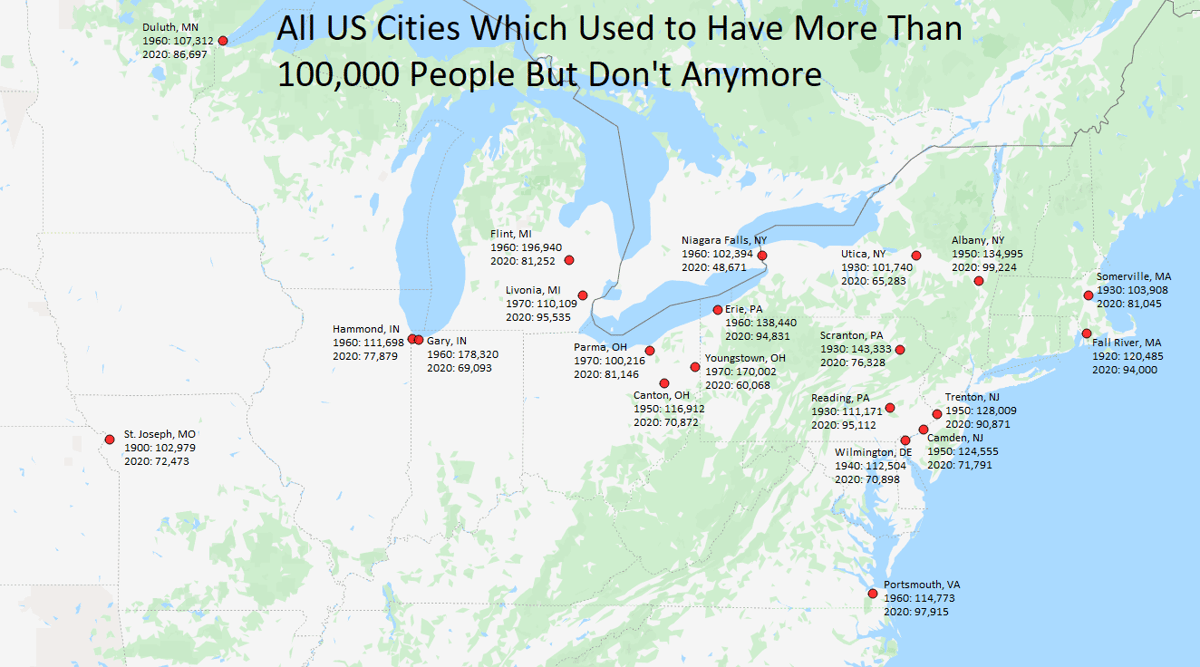
Here’s a map of the 21 US cities that used to have a population of 100,000 people but don’t anymore. Many of these are Rust Belt cities, in which manufacturing employment fell steeply during the latter part of the 20th century.
The thread at Reddit mentions Detroit and St. Louis as two other cities whose population has dropped during that same time period. Detroit went from 1.85 million in 1950 to 639,000 in 2020 and St. Louis dropped from 857,000 to 300,000 over the same time period:
St. Louis was once the country’s 4th largest city. Worlds Fair and Olympics in 1904. Two Major League Baseball teams. It didn’t boom as much as the Great Lakes cities in between the wars and it declined just as much after.
Tags: demographics · maps · population · usa
We’re Squandering LEDs’ Potential to Save Our Night Skies. “Our main failure isn’t a technical one. It’s that we have yet to revise our thinking about lighting at night. We use LED technology just as we did the old sources of light.”
As I've shown in the past, the run value of an ABS Challenge is impacted greatly by the ball-strike count (especially the 3-2 count which will flip the plate appearance walk <==> strikeout, while a 1-0 v 0-1 count is hardly eventful), as well as the runners on base (especially bases loaded in which case an entire run is on the table).
Looking at calls where the run value has very low impact (under 0.1 runs), low impact (0.1 to under 0.2 runs), medium impact (0.2 to under 0.3 runs) and high impact (at least 0.3 runs), we can see how our players perform. When it's a very-low-impact challenge, the breakeven point is much higher, and so we expect a much higher success rate. You can't risk a challenge to gain 0.05 runs, but you can risk a challenge if you can gain 1.8 runs.
Let's start with pitchers, where they challenged 28, 26, 22, 20 times respectively for the very-low thru to the high-impact groups noted above. Pitchers are smart! At least directionally. They succeed 54%, 31%, 32%, and 15% respectively. So, 54% success rate when it's very-low-impact and 15% when it's high impact. Like I said: directionally-sound. But magnitude-wise? Ouch. A very very big ouch.
How about their battery mates? 62%, 62%, 61%, 48%. So, catchers are very smart, both with a big success rate of 48% with the high-impact challenge, and an even higher success rate at lower impact. What is interesting is that catchers basically have only TWO mindsets: high-impact and other. Which is somewhat fine. In that regard, they should just stop challenging the very low-impact pitches: 62% to only gain ~0.06 runs is just not worth it.
How about batters? Success rates of: 50%, 53%, 41%, 40%. So, the same directional/binary mindset as catchers, except different thresholds. Batters are looking to be riskier when run value is .20+ runs (while catchers are looking for .30+ runs). And really, getting 50% overturns while gaining ~0.06 runs is really not worth it.
So, since all three groups are able to isolate the high-impact situations, they should be challenging those alot more while challenging the low-impact pitches alot less.
Next Page of Stories